45 Local SEO Statistics for 2026 (Sourced and Updated)
Last updated: November 2026. Every statistic below links to its original source and is labeled with the year the data was published.
Local businesses that serve a physical location or a service area depend on being found in local search. Most consumers look up a local business online before they call, visit, or book, and a growing share now also ask AI tools for recommendations. A local SEO strategy is how a business makes sure it shows up in those moments.
This page collects current local SEO statistics from primary sources: BrightLocal’s consumer surveys, Whitespark’s Local Search Ranking Factors, Pew Research Center, Ahrefs, and Google itself. Older figures that are still widely cited are kept in a separate section with their original year so they are not mistaken for current data.
Key takeaways
- 84% of US consumers searched online for a local business in the last three months (BrightLocal, 2026).
- 52% started their most recent local search on Google Search and 9% on Google Maps; 75% used more than one channel (BrightLocal, 2026).
- 72% of consumers look at three or fewer businesses before deciding, and 75% decide in under 30 minutes (BrightLocal, 2026).
- 97% of consumers read reviews for local businesses, and 68% will only use a business rated four stars or higher, up from 55% in 2025 (BrightLocal, 2026).
- 45% of consumers used ChatGPT or another AI tool for local business recommendations in the past year, up from 6% the year before (BrightLocal, 2026).
- Primary Google Business Profile category, proximity, and keywords in the business title are the top three local pack ranking factors in the 2026 expert survey (Whitespark, 2026).
- Google users clicked a traditional search result on 8% of visits when an AI summary appeared, versus 15% without one (Pew Research Center, 2025).
These statistics help answer three practical questions:
- What are the search engine factors that contribute to your local online presence?
- What should you look for when hiring a local SEO services provider?
- How can you make a strong case for investing in Google My Business SEO to your chief marketing officer (CMO) or chief executive officer (CEO)?
Note: We’ve released our own free local rank checker that you can use to audit your website.
Related: Local SEO Audit
How consumers search for local businesses in 2026
BrightLocal’s 2026 Consumer Search Behavior research surveyed 1,227 US consumers who had searched for a local business online in the previous three months. Its three reports (speed, channels, and decisions) are the most current large-sample view of how people find local businesses.
- 84% of US consumers searched online for a local business in the last three months (BrightLocal, 2026).
- 52% of consumers started their most recent local business search on Google Search and a further 9% started on Google Maps. 71% used Google Search at some point during that search (BrightLocal, 2026).
- 75% of consumers used more than one channel during their most recent local business search. Social media, AI tools, and review sites were used by 30%, 23%, and 19% of consumers respectively (BrightLocal, 2026).
- 73% of consumers started their most recent local search on a mobile phone, 19% on a computer, and 8% on a tablet (BrightLocal, 2026).
- 75% of consumers take less than 30 minutes to decide which local business to use, and 28% decide in under five minutes (BrightLocal, 2026).
- 72% of consumers look at three or fewer businesses before making a decision. Only 1% look at more than ten (BrightLocal, 2026).
- Only 6% of consumers “just clicked the top result.” The factors people check most when researching are the address or how nearby the business is (44%), the star rating (38%), the number of reviews (37%), and whether the listing has complete information (34%) (BrightLocal, 2026).
- 52% of consumers looked at a business during their most recent search and decided not to contact it (BrightLocal, 2026).
- More than 2 billion people use Google Maps each month, according to Google (Google, 2024).
What this means for law firms and other professional services
For professional services, BrightLocal found that proximity matters less than average (29%). Consumers researching these businesses focus more on the number of reviews (40%), the star rating (35%), and whether information appears complete (30%) (BrightLocal, 2026). For a law firm, that puts reviews and a complete Google Business Profile ahead of office location when a prospective client is comparing options.
Online review statistics
BrightLocal’s Local Consumer Review Survey 2026 (1,002 US adults, published February 2026) is the longest-running annual survey of how consumers use reviews to choose local businesses.
- 97% of consumers read reviews for local businesses, and 41% “always” read them, up from 29% in 2025 (BrightLocal, 2026).
- 71% of consumers used Google to read reviews, down from 83% in 2025. Use of ChatGPT and other generative AI tools for local recommendations rose from 6% to 45%, making AI the third most-used source. Apple Maps rose from 14% to 27% (BrightLocal, 2026).
- 68% of consumers will only use a business with a rating of four stars or higher, up from 55% in 2025. 31% will only use a business rated 4.5 stars or higher, up from 17% (BrightLocal, 2026).
- 74% of consumers only care about reviews written in the last three months, and 32% look for reviews from the last two weeks, up from 20% the year before (BrightLocal, 2026).
- 47% of consumers won’t use a business with fewer than 20 reviews (BrightLocal, 2026).
- 85% of consumers say positive reviews make them more likely to use a business, and 77% say negative reviews make them less likely (BrightLocal, 2026).
- 49% of consumers trust online reviews from strangers about as much as personal recommendations (BrightLocal, 2026).
- 89% of consumers expect business owners to respond to reviews. 80% say they are likely to use a business that responds to all of its reviews, while generic or templated replies put off 50% (BrightLocal, 2026).
- 19% of consumers expect a response on the same day they post a review, up from 6% in 2025 (BrightLocal, 2026).
- In 2025, Google blocked or removed more than 292 million policy-violating reviews on Maps, published more than 1 billion reviews, and removed more than 13 million fake Business Profiles (Google, 2026).
Google Business Profile and business listing statistics
Accurate, actively managed listings are one of the few local factors a business fully controls.
- Only 35% of US small and medium-sized businesses have a Google Business Profile, and only 40% have a dedicated website, even though 72% say SEO has a medium-to-high impact on their business (BrightLocal, 2025).
- 96% of consumers think it is important for a local business to actively manage how it appears online (BrightLocal, 2026).
- Among consumers who decided not to contact a business, 20% cited missing or incorrect information and 16% said the listing looked abandoned or unclaimed (BrightLocal, 2026).
- 62% of consumers would avoid using a business if they found incorrect information about it online (BrightLocal, 2023).
- The most trusted platforms for researching local businesses are Google (66%), Google Maps (45%), and the business’s own website (36%) (BrightLocal, 2023).
- In BrightLocal’s earlier 2021 report, 85% of consumers said they had found incorrect or incomplete information on a business listing in the past year, and 63% said finding incorrect information would stop them from using that business (BrightLocal, 2021).
Local search ranking factors
Whitespark’s 2026 Local Search Ranking Factors report (published November 2025) asks local SEO experts to score 187 factors. It is a survey of practitioner opinion, not data from Google, but it is the most widely referenced study of its kind. For how these factors apply to legal practices, see our guide to attorney SEO ranking factors.
- The top five local pack and Google Maps factors are: primary Google Business Profile category, proximity of the address to the searcher, keywords in the Google Business Profile business title, a physical address in the city of the search, and whether the business is open at the time of the search (Whitespark, 2026).
- The top three local organic factors are a dedicated page for each service, geographic (city or neighborhood) keyword relevance of content, and the quality and authority of inbound links to the domain (Whitespark, 2026).
- Compared with the previous edition, experts gave more weight to review signals and behavioral signals, while citations lost about half a percentage point of importance (Whitespark, 2026).
- “Presence of Google Business Profile predefined services” was added as a factor for the first time and ranked #22 for local pack visibility (Whitespark, 2026).
- For AI search visibility, a new category in this edition, the top-rated factor was being included on expert-curated “best of” and similar lists, followed by having a dedicated page for each service (Whitespark, 2026).
Proximity has carried more weight in local results since Google’s December 2021 local algorithm change, widely called the “Vicinity update” (Sterling Sky, 2021).
AI search and local visibility statistics
AI Overviews, Google AI Mode, and ChatGPT now sit between many searchers and local websites. Early research shows fewer clicks from AI-heavy results, but consumers still verify AI recommendations before contacting a business.
- Google users who saw an AI summary clicked a traditional search result on 8% of visits, compared with 15% of visits when no AI summary appeared. Users clicked a link inside the AI summary on just 1% of visits (Pew Research Center, 2025).
- Google users ended their browsing session on 26% of search pages with an AI summary, compared with 16% of pages with only traditional results (Pew Research Center, 2025).
- 58% of US adults in Pew’s panel ran at least one Google search in March 2025 that produced an AI summary (Pew Research Center, 2025).
- For informational keywords, the presence of an AI Overview correlated with a 58% lower average click-through rate for the top-ranking page, based on December 2025 data for 300,000 keywords (Ahrefs, 2026).
- Across 200,000 localized AI searches, Google Maps mentioned a tracked business in 66% of searches, compared with 32% to 38% for ChatGPT, Google AI Mode, and AI Overviews (BrightLocal, 2026).
- Business websites made up 93% of all unique domains cited as sources in local AI answers and 42% of all citations (BrightLocal, 2026).
- Among consumers who used AI tools in their local search, only 18% felt ready to contact the business the AI recommended. Of consumers who started on an AI tool, 43% went on to check Google (BrightLocal, 2026).
- 88% of consumers who use AI for local recommendations fact-check the reviews AI tools cite (BrightLocal, 2026).
Older local SEO statistics that are still widely cited
The figures below come from studies that have not been repeated. They are accurate to their sources but reflect the year shown, so use them as historical context rather than current benchmarks.
- 98% of consumers used the internet to find information about local businesses in 2022, up from 90% in 2019, and 87% used Google to evaluate local businesses in 2022 (BrightLocal, 2023).
- For local queries, 42% of searchers clicked on a result in the Google Map Pack, and searchers used one of Google’s autocomplete suggestions 23% of the time, in a study of 1,801 search sessions (Backlinko, 2020).
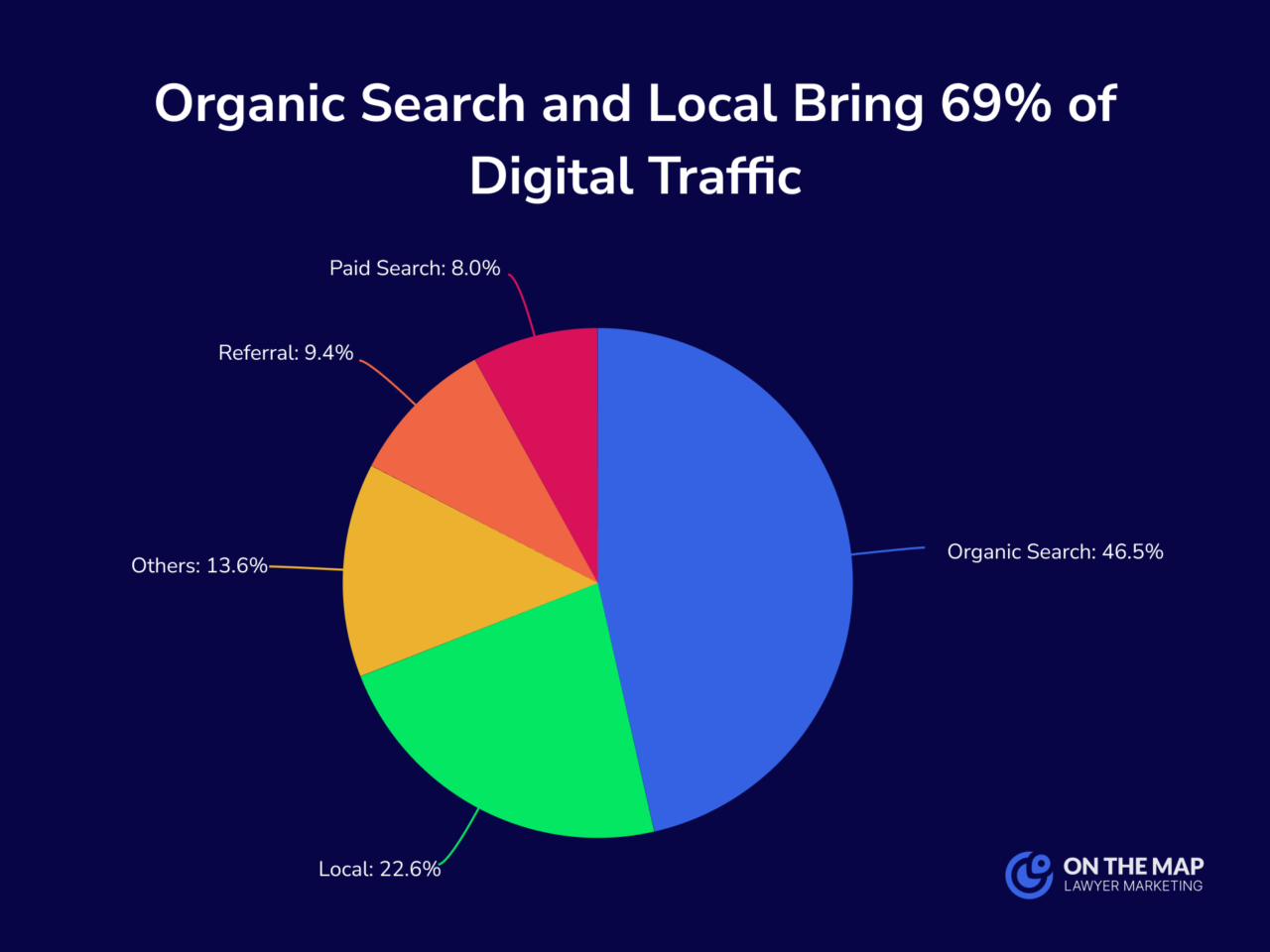
- In a study of more than 500 location-based business websites, organic search and local search together drove 69% of website sessions, with local search contributing 22.6%. Local’s share of traffic rose from 19.2% to 28.8% between January 2020 and June 2021, and local visitors viewed 3.92 pages per session on average, the most of any top channel (Milestone Research, 2021).
- 57% of local search queries were submitted on a mobile device or tablet, and 42% of millennials who perform a local search said they visit the business most of the time (ReviewTrackers, 2021).
- After Google replaced the 7-pack with the 3-pack, the new local pack appeared in the #1 organic position 93% of the time for the keywords studied, up from 25% for the old 7-pack (seoClarity, 2015).
Final thoughts
The 2026 data points in one direction: consumers still start most local searches on Google, decide quickly from a short list, and judge businesses on recent reviews, star ratings, and complete, accurate listings. AI tools are adding a new discovery layer, but consumers verify what AI tells them on Google, review sites, and business websites before they make contact.
For more data, read our compilations of Google Maps statistics, local business stats, and SEO statistics.
Whether you need local SEO for lawyers, a law firm SEO agency, affordable SEO services for a small business, or Google My Business listing optimization, On The Map Marketing is a digital marketing agency that offers local link building, content marketing, and website design. Learn more about our work as a law firm digital marketing agency.
Book a consultation with us to explore how we can help you launch a local SEO campaign.
Table of Contents
Related Articles

Dominate Your Market with Digital Marketing Services That Deliver
Talk to a certified professional today, and we will design a strategy specific to your case.