
Legal Marketing Statistics 2026: The Current State of Law Firm Marketing
Law Firm Marketing Strategy » Legal Marketing Statistics 2026: The Current State of Law Firm Marketing
It is no longer enough to just be a great law firm and expect clients via word of mouth or referrals at the courthouse. You need to create a digital marketing strategy for your law firm. You have to build a presence on online channels where your prospects are searching for firms.
But which marketing channels should your law firm focus on? How to create an effective law firm marketing strategy? And should you hire a legal marketing agency, or go a DIY route? This page collects the most current legal marketing statistics we could verify, each linked to its original source and labeled with the year the data was published.
Last updated: November 2026. Older figures that have not been replaced by a newer edition are kept and clearly dated.
Related reading: Future of Legal Marketing
Key takeaways
- Search is still the front door: 97% of consumers who researched their attorney online used a search engine, and 82% of those who found a lawyer online relied on online reviews (FindLaw, 2024).
- AI is now part of the client journey: more than half of consumers have used or would consider using AI to answer legal questions (Clio, 2025), and use of ChatGPT and other generative AI tools for local business recommendations rose from 6% to 45% in a year (BrightLocal, 2026).
- Legal is the most expensive search ad category: Attorneys & Legal Services average $9.87 per click and $131.63 per lead, the highest of 23 industries tracked (LocaliQ/WordStream, 2026).
- Review expectations are rising: 68% of consumers will only use a business with four or more stars, up from 55% in 2025, and 47% will not use a business with fewer than 20 reviews (BrightLocal, 2026).
- Many firms market without a plan: only 47% of ABA survey respondents said their firm had an annual marketing budget, down from 57% in 2022 (ABA, 2023).
Legal market statistics (2025–2026)
These figures describe the size and direction of the US legal market your firm is competing in.
1. There were 1.37 million lawyers in the US in 2025, up from 1.35 million the previous year, the first significant increase since 2020. (ABA, 2025 Profile of the Legal Profession)
2. Demand for law firm services (billable hours worked) grew 1.9% for the average firm in 2025, the third-best year for demand growth since the Global Financial Crisis. (Thomson Reuters Institute, 2026 Report on the State of the US Legal Market)
3. The average law firm’s worked rates increased 7.3% in 2025, and average profit growth was 13.0%. (Thomson Reuters Institute, 2026 Report on the State of the US Legal Market)
4. Law firm technology spending grew 9.7% in 2025 over 2024. (Thomson Reuters Institute, 2026 Report on the State of the US Legal Market)
5. 90% of all legal dollars still flow through standard hourly rate arrangements, according to Thomson Reuters Legal Tracker data cited in the 2026 report. (Thomson Reuters Institute, 2026 Report on the State of the US Legal Market)
6. 59% of firms billed flat fees, either exclusively or in addition to hourly rates, in 2024. (Clio, 2025 Legal Trends Report)
Note: the Thomson Reuters figures are based on reported results from 184 US-based law firms (Am Law 100, Am Law Second Hundred and Midsize firms), so they reflect larger firms more than solo and small practices.
How legal consumers find and choose a lawyer
1. 97% of respondents who searched for online information about the attorney they contacted used search engines. (2024 survey of 2,000 US adults with a legal need in the past year) (FindLaw, 2024 U.S. Consumer Legal Needs Survey)
2. Among respondents who contacted an attorney and learned about them online, 82% relied on online reviews, and nearly 40% of those who used reviews cited them as their primary source of information. (FindLaw, 2024 U.S. Consumer Legal Needs Survey)
3. Nearly nine in ten adults who searched online visited at least two websites before contacting an attorney. (FindLaw, 2024 U.S. Consumer Legal Needs Survey)
4. 56% of respondents take action toward their legal need within a week or sooner. (FindLaw, 2024 U.S. Consumer Legal Needs Survey)
5. Of consumers who hired a lawyer recently, 70% said they had an easy time finding and hiring one, largely thanks to referrals and online searches. (Clio, 2025 Legal Trends Report)
6. 24% of consumers said they would be unlikely to rehire the lawyer they last worked with. (Clio, 2025 Legal Trends Report)
7. In 2022, law firms reported that clients most often made first contact by phone (46%), with email a distant second (27%). (CallRail, 2022 Marketing Outlook for Law Firms)
Because so many prospects compare several firms before calling, your website and review profile do much of the selling. See our guide to local SEO for law firms.
AI and legal marketing statistics
1. More than half of consumers have used or would consider using AI to answer their legal questions. (Clio, 2025 Legal Trends Report)
2. Among consumers who used AI for a legal question, 28% were directed by the AI to contact a lawyer, and in 12% of cases the AI convinced them their legal problem was not worth pursuing. (Clio, 2025 Legal Trends Report)
3. Use of ChatGPT and other generative AI tools for local business recommendations rose from 6% in 2025 to 45% in 2026, making it the third most popular source of business recommendations. (BrightLocal, Local Consumer Review Survey 2026)
4. 82% of consumers read AI-generated review summaries to inform their decisions; only 18% skip them. (BrightLocal, Local Consumer Review Survey 2026)
5. 79% of legal professionals use AI in their firms. (Clio, 2025 Legal Trends Report)
6. 36% of legal professionals say AI has had a positive influence on revenues; among wide adopters of AI, that rises to 69%. (Clio, 2025 Legal Trends Report)
7. Just 40% of legal professionals use a legal-specific AI solution, down from 58% in 2024. (Clio, 2025 Legal Trends Report)
Online review and local search statistics
BrightLocal’s survey covers consumers choosing local businesses in general, not only law firms, but the same expectations apply to firms that compete in the map pack. (2026 survey of 1,002 US adults)
1. 97% of consumers read online reviews, and 41% “always” read reviews when browsing for businesses, up from 29% the year before. (BrightLocal, Local Consumer Review Survey 2026)
2. Google remains the top review source, but its share dipped from 83% in 2025 to 71% in 2026. (BrightLocal, Local Consumer Review Survey 2026)
3. 47% of consumers will not use a business with fewer than 20 reviews, and 74% only care about reviews written in the last three months. (BrightLocal, Local Consumer Review Survey 2026)
4. 68% of consumers will only use a business with four or more stars, up from 55% in 2025. (BrightLocal, Local Consumer Review Survey 2026)
5. 89% of consumers expect a response to their reviews; 19% expect it the same day, up from 6% the year before. (BrightLocal, Local Consumer Review Survey 2026)
6. Generic or templated review replies put off 50% of consumers. (BrightLocal, Local Consumer Review Survey 2026)
Paid search and PPC statistics for law firms
1. The average cost per click for Attorneys & Legal Services search ads is $9.87, the highest of the 23 industries tracked, versus $5.42 across all industries. (LocaliQ/WordStream, 2026 Search Advertising Benchmarks)
2. The average cost per lead for Attorneys & Legal Services is $131.63, also the highest of the 23 industries, versus $66.69 across all industries. (LocaliQ/WordStream, 2026 Search Advertising Benchmarks)
3. Legal search ads average a 5.87% click-through rate and a 5.55% conversion rate (all-industry averages: 6.64% and 8.18%). (LocaliQ/WordStream, 2026 Search Advertising Benchmarks)
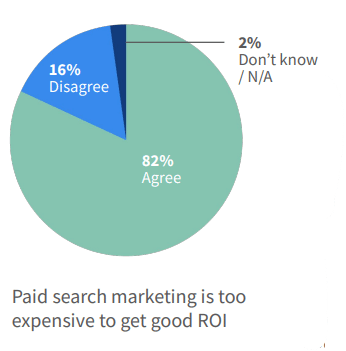
4. In a 2022 survey, 78% of law firms whose clients find them through search said they engage in paid search marketing, but 82% of those said paid search is too expensive to get good ROI. (CallRail, 2022 Marketing Outlook for Law Firms)
Note: If you’re contemplating paid marketing, you can consider our law firm PPC services.
Law firm website and marketing statistics (ABA TechReport)
The ABA Legal Technology Survey is the longest-running survey of how lawyers themselves market their practices. The latest published websites and marketing data come from the 2023 and 2024 TechReports.
1. 90% of respondents reported that their firm has a website in 2024, down from 94% in 2022. Solo practitioners rose to 70% (from 61% in 2022), and 100% of firms with 100+ attorneys have one. (ABA, 2024 Websites & Marketing TechReport)
2. Use of social media as a marketing tool declined to 80% in 2024, from 89% in 2022. LinkedIn remains the primary platform (76%), followed by Facebook (53%). (ABA, 2024 Websites & Marketing TechReport)
3. Confidence in marketing strategy varies by firm size: larger firms rated their confidence 3.3 out of 5, compared to 2.7 for solos and small firms (2024). (ABA, 2024 Websites & Marketing TechReport)
4. Only 47% of respondents said their firm had an annual marketing budget in 2023, down from 57% in 2022. 80% of solo practitioners did not have a marketing budget. (ABA, 2023 Websites & Marketing TechReport)
5. Only about 20% of respondents receive regular marketing performance reports (19% from an external agency, 20% from an internal team). (ABA, 2023 Websites & Marketing TechReport)
6. 58% of respondents say attorneys perform marketing activities in their firms. (ABA, 2023 Websites & Marketing TechReport)
7. 35% of respondents reported having a client retain them directly through the firm’s website, up from 25% in 2022. (ABA, 2023 Websites & Marketing TechReport)
8. Only 15% of respondents said their firm’s website lets visitors schedule an initial consultation. (ABA, 2023 Websites & Marketing TechReport)
9. 81% of respondents’ firms do not offer live chat on their website; only 12% were sure their firm’s site did. (ABA, 2023 Websites & Marketing TechReport)
10. 74% of respondents say their firm’s website is mobile friendly. Only 44% said their site uses SSL (HTTPS), while another 48% did not know. (ABA, 2023 Websites & Marketing TechReport)
11. One third of respondents say their firm has a blog, and 29% of those with firm blogs report that clients have retained the firm directly or via referral from the blog. (ABA, 2023 Websites & Marketing TechReport)
12. Only 30% of respondents said their firms produce video to market the practice, up from 24% in 2020. Email newsletters are used by 41% of firms. (ABA, 2023 Websites & Marketing TechReport)
A legal blog could be a great source of leads for your firm as well. If your site is due for a rebuild, see our roundup of the best attorney websites.
Law firm marketing budget and channel statistics (2022 survey)
How much does the average law firm spend on marketing? The most detailed public breakdown of law firm channel budgets is still CallRail’s 2022 survey of more than 500 US-based law firm employees. No newer edition with the same questions has been published, so these figures are kept and dated 2022.
1. On average, law firms allocated their marketing budgets as follows: 28% to online marketing channels, 19% to print and/or billboard ads, 17% to TV ads, 16% to networking events, 14% to podcast/radio spots and 10% to other activities. (CallRail, 2022 Marketing Outlook for Law Firms)
2. Of online marketing spend, the largest shares went to the website (24%), paid advertising (18%), SEO (17%), social media (17%) and email marketing (16%). (CallRail, 2022 Marketing Outlook for Law Firms)
3. 66% of firms planned to increase their website budget, and 48% planned to increase the online marketing budget allocated to popular channels. (CallRail, 2022 Marketing Outlook for Law Firms)
4. 95% of firms agreed that because marketing is non-billable, the spending risk is perceived to be greater, making it even more important to use those dollars effectively. (CallRail, 2022 Marketing Outlook for Law Firms)
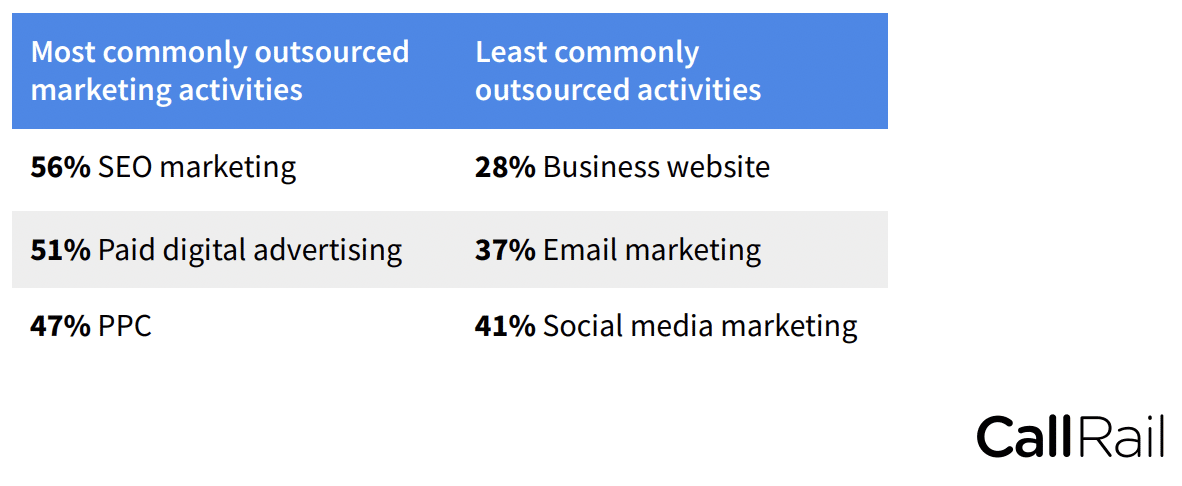
5. 83% of firms outsource marketing work; 17% do not outsource any. The most commonly outsourced activities were SEO (56%), paid digital advertising (51%) and PPC (47%). (CallRail, 2022 Marketing Outlook for Law Firms)
6. 71% of firms said they are “somewhat” to “very involved” in marketing strategy. (CallRail, 2022 Marketing Outlook for Law Firms)
7. 91% of firms said their area of law generally sees repeat clients, and 45% use remarketing to keep in touch with unconverted leads. (CallRail, 2022 Marketing Outlook for Law Firms)
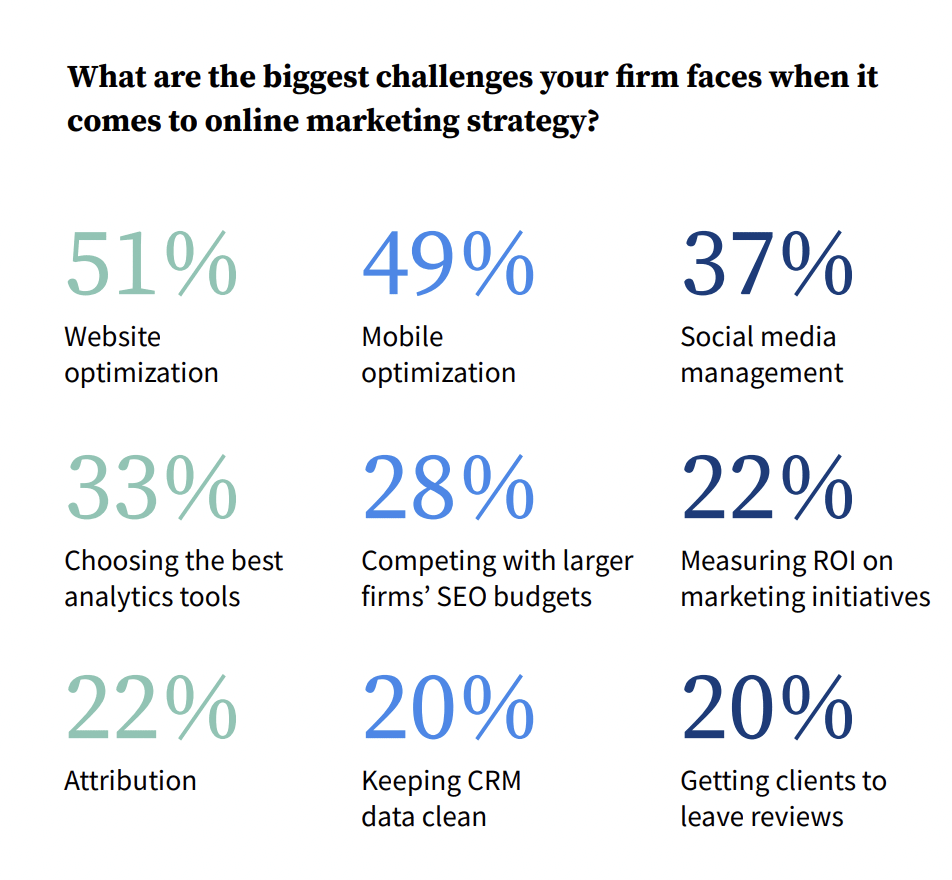
8. Website optimization (51%), mobile optimization (49%) and social media management (37%) were the biggest online marketing challenges firms reported. (CallRail, 2022 Marketing Outlook for Law Firms)
9. Social media was ranked the most valuable lead channel and also the #1 underperforming channel (47%), followed by email marketing (46%). (CallRail, 2022 Marketing Outlook for Law Firms)
10. 85% of firms used intake software. Of those, 98% said it helps them make better marketing decisions, 65% said it helps them close more clients and 79% said it helps them waste less time. (CallRail, 2022 Marketing Outlook for Law Firms)
11. The most common reporting tools firms used to decide marketing spend were Google Analytics (51%), Facebook Insights (45%) and Twitter Analytics (37%). (CallRail, 2022 Marketing Outlook for Law Firms)



If you’re facing a similar issue, why not hire our law firm SEO experts?
Where law firms said their leads came from (2022)
1. Online lead sources reported by firms: organic social media (84%), search engines (42%), professional directories (41%) and online review sites such as Yelp (33%). (CallRail, 2022 Marketing Outlook for Law Firms)
2. Offline lead sources: direct referrals from former clients (40%), general word of mouth/name recognition (40%), TV advertisements (26%) and print advertisements (22%). (CallRail, 2022 Marketing Outlook for Law Firms)
3. Email was the #1 channel firms used to reach unconverted leads. (CallRail, 2022 Marketing Outlook for Law Firms)

Social media lead attribution is self-reported by firms. For our view on the channel, see social media for law firms and our guide to lead generation for lawyers.
SEO stats on the legal industry
We have covered law firm SEO statistics here in more detail. Public, independently audited data on law firm SEO returns is scarce; the figures below come from one agency’s own client data and should be read as directional.
1. Across its law firm clients, First Page Sage reports an average annual SEO spend of $120,000, an average time to break even of 14 months, a 21% increase in organic traffic and a three-year SEO ROI of 526%. (Client data from 2018–2022; report last updated February 21, 2024) (First Page Sage, Law Firm SEO Statistics)
2. In the 2022 CallRail survey, 28% of firms said competing with larger firms’ SEO budgets was one of their biggest online marketing challenges. (CallRail, 2022 Marketing Outlook for Law Firms)
If you’re weighing an investment in search engine optimization, see our guide on SEO for lawyers and our law firm SEO pricing.
Final thoughts
Whatever your practice area, digital marketing is important for your firm. The data above shows where legal consumers look, what they expect, and what each channel costs.
Hopefully, the legal marketing stats in this article give you a good idea of the direction of your firm’s marketing strategy.